




Introduction

I would like to thank ICY DOCK for supplying the review sample.
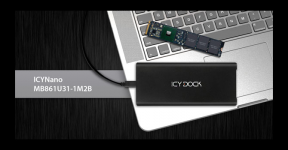
There are a slew of NVMe to USB based enclosures out there, with some, being a bit basic, offering a low entry price, while others go as far as utilizing various metals and acting as a heatsink. While the ICY DOCK ICYNano MB861U31-1M2B we are reviewing here falls into the latter category, it is also one of the few that can hold up to 22110 NVMe drives. Such dimensions are usually reserved for enterprise-grade drives with power-loss protection and make up maybe 5% of the SSD market.
Packaging and Contents
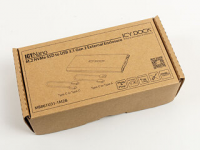
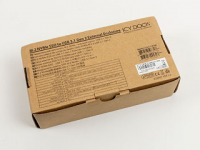
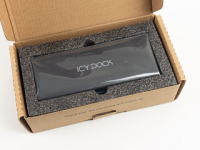
The ICY Dock ICYNano MB861U31-1M2B ships in a plain brown cardboard box with an image of the device on top and a list of specifications on the bottom. To ensure you will get your unit in pristine condition, the enclosure itself, which is a bit larger than others, has been placed inside a thick plastic bag and nicely set in a foam cutout.
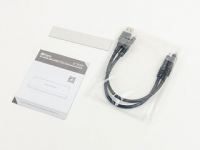
Underneath of this is where you will find the accessories consisting of two cables: one for USB-C and another for USB Type-A equipped host systems. Additionally, you will find a thermal pad and a basic manual within the package.
A Closer Look
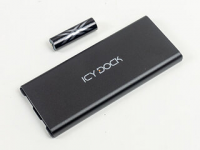
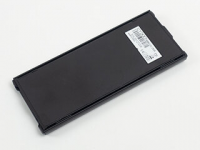
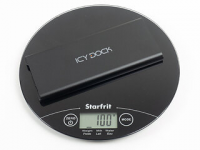
Next to the AA battery out of the box, it becomes quite apparent that the ICYNano naming may be a little bit of a stretch. After all, this enclosure is one of just a few capable of holding up to a 22110 NVMe drive. In terms of weight, the unit clocks in at exactly 100 grams, which is pretty much right in the norm for a metal enclosure like this.
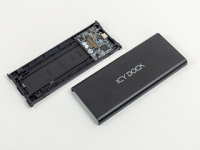
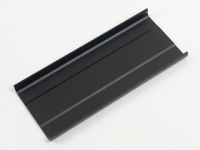
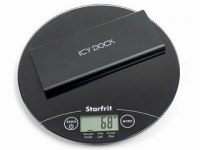
You do not need any tools to take it apart—just pull the top cover off the chassis to reveal the sled in which any NVMe drive will sit. The top is made out of aluminium and also acts as the drive's heatsink. It alone makes up more than two-thirds of the entire unit's weight at 68 grams. Plenty of cooling potential there. It is built in a way that covers your entire SSD no matter how long.
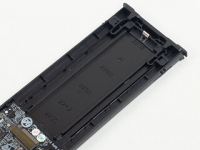
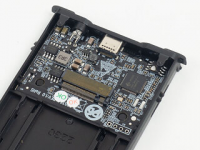
The bottom tray is clearly marked with the various SSD lengths and features a tool-less installation mechanism we have seen in other ICY DOCK products in the past. The end of the tray with the USB-C connector sports a surprisingly busy PCB with JMicron's JMS583 controller at the heart of it. This IC was one of the first that could handle full-speed USB 3.2 Gen 2 10 Gbps. It supports USB 3.2 Gen 2 on the USB side and PCI-Express x2 3.0 for attached devices.
Assembly
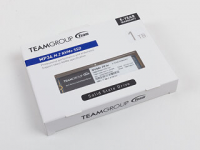
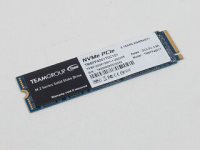
While we tend to disassemble drives at this stage, with the ICYNano being an empty enclosure, now is a good time to go through the assembly instead. Teamgroup provided us with a 1 TB drive of the Phison E12S based MP34. If you want to find out more about the drive, check out our review of the 512 GB model here.
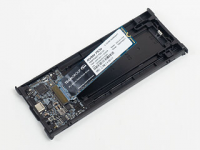
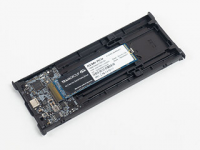
Adding the drive is pretty straightforward. First, simply insert it at a 45 degree angle and push it down. With that done, secure it by sliding the plastic locking mechanism down until it snaps into place. This whole tool-less approach could prove useful for when you need to take a drive from within a downed host system for data access through a notebook, for example.
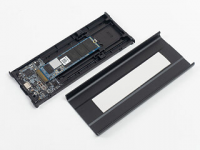
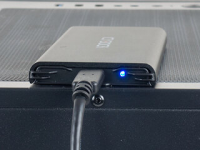
I actually peeled off the Teamgroup sticker so that the thermal pad would make direct contact with the drive ICs, but remember that taking the sticker off will most likely void the warranty. That said, I doubt it would make a huge difference in our scenario, and I should mention that some SSD brands actually place a copper heatspreader underneath their sticker, which you don't want to remove. Once connected, there is a visible blue activity LED that lights up to let you know data is being moved around.
Random IO
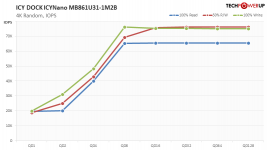
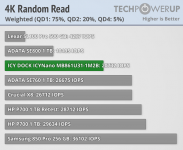
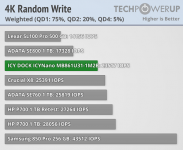
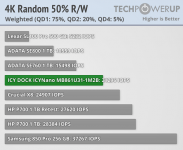
Random read/write performance matters if you copy a lot of small files or use the drive as storage for games and applications that are directly run off the drive.
Sequential IO
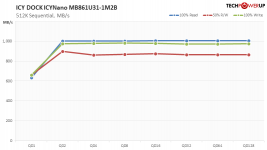
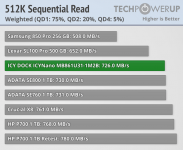
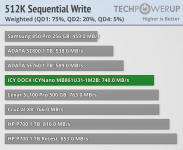
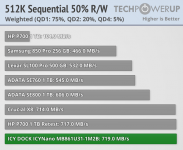
Sequential performance is relevant when you copy large files—videos, for example.
Sustained Write Speeds
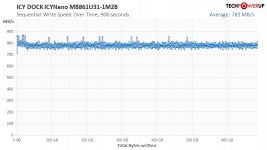
Thanks to the large heatsink, the Teamgroup MP34 drive cranks through the entire test without breaking a sweat, sustaining full performance with an average of 781 MB/s. This shows that the included black aluminium heatsink is truly valuable; a heatsink is absolutely something you should look for when buying an enclosure like this.
Value and Conclusion
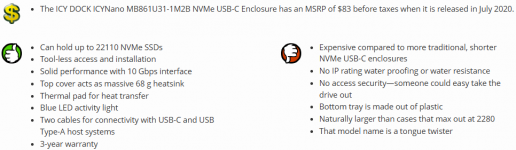
Well, there is not much to be said of the data transfer speed of the ICY DOCK ICYNano MB861U31-1M2B other than that it is on par with what we would expect with the embedded JMicron controller. That is good as the IC pairs quite well with NVMe drives and the USB-C 10 Gbps interface. On top of that, assembly is completely tool-less from opening the enclosure to installing an NVMe drive securely.
That means anyone can take a drive from a non-functioning host system to access all the data quickly and without having to scramble for a (tiny) screw driver. This could prove especially important for mission-critical enterprise-level storage environments, which is exactly where you are bound to see 22110 drives. With the ability to hold and cool such specific NVMe storage devices, ICY DOCK stays true to their target audience with the ICY DOCK ICYNano MB861U31-1M2B NVMe USB-C enclosure. In that same breath, it would have been nice if the enclosure were completely made out of a metal, at least externally, while, in a ideal world, even providing more dust/liquid resistance. If you can look past that and require the ability to handle any M.2 NVMe SSD format out there easily and quickly, the ICY DOCK ICYNano MB861U31-1M2B NVMe USB-C enclosure is absolutely a solid choice.
But let's talk about pricing. ICY DOCK mentions an MSRP that is more than double what other NVMe enclosures tend to go for. Many devices of good quality clock in around $30–$40 in retail, but can only handle up to 2280 drives, while those few that allow for 22110 tend to start at $45, but are not as refined and well engineered, usually stemming from some random factory with an OEM PCB and just a simple housing to accommodate the additional length of such a drive. Thus, you are paying for that fairly unique compatibility, in-house development, the long-term warranty, and the fact that it is tool-less. But answering the question of whether the roughly $35 premium is worth it, well, that is a solid no for traditional end users. However, price is not a factor for government, military, or critical system environments, which is exactly the market ICY DOCK is going for with this enclosure.


Last edited: